
Jersey County Court Records After a Jail Arrest
When someone is arrested and booked in Jersey County, the case does not become a court record until the State's Attorney reviews it and files charges. Ben Goetten is the Jersey County State's Attorney, and his office decides what to charge, whether to proceed, and how. That filing opens a case in the circuit court, and from that point the court record, not the jail booking sheet, is the authoritative source for what a person is formally accused of after an arrest.
The booking side and the court side answer different questions. For custody, booking detail, and the roster, the jail inmate records page is the place to start, and booking photos are covered on the jail mugshots page. The court record itself, including the charges the prosecutor actually filed and the dates that follow, is tracked through the Jersey County Circuit Clerk and the Judici portal.
How to Find Jersey County Court Records After an Arrest
Jersey County criminal cases are handled by the Office of the Circuit Clerk, Mitchell P. Reynolds, at the courthouse on West Pearl Street, and the public search runs through Judici. The clerk gives an exact name format: type the last name, a comma, a space, then the first name, such as "Haskell, Eddie." Charge and case detail show up in the case, while the arrest and booking detail stay on the jail side.
- Open the Jersey County Judici page and choose the cases search.
- Enter the defendant as last name, comma, space, first name, or use a case number if you have one.
- Open the case to read the charge list filed by the State's Attorney.
- Check each charge's level and current status, along with the next hearing date.
For a statewide criminal history rather than a single county case, the Illinois State Police Bureau of Identification releases conviction information to the public under the Uniform Conviction Information Act, which is a different record from a jail booking.
The Jersey County Judici welcome page is the entry point the Circuit Clerk links for court-case searches.
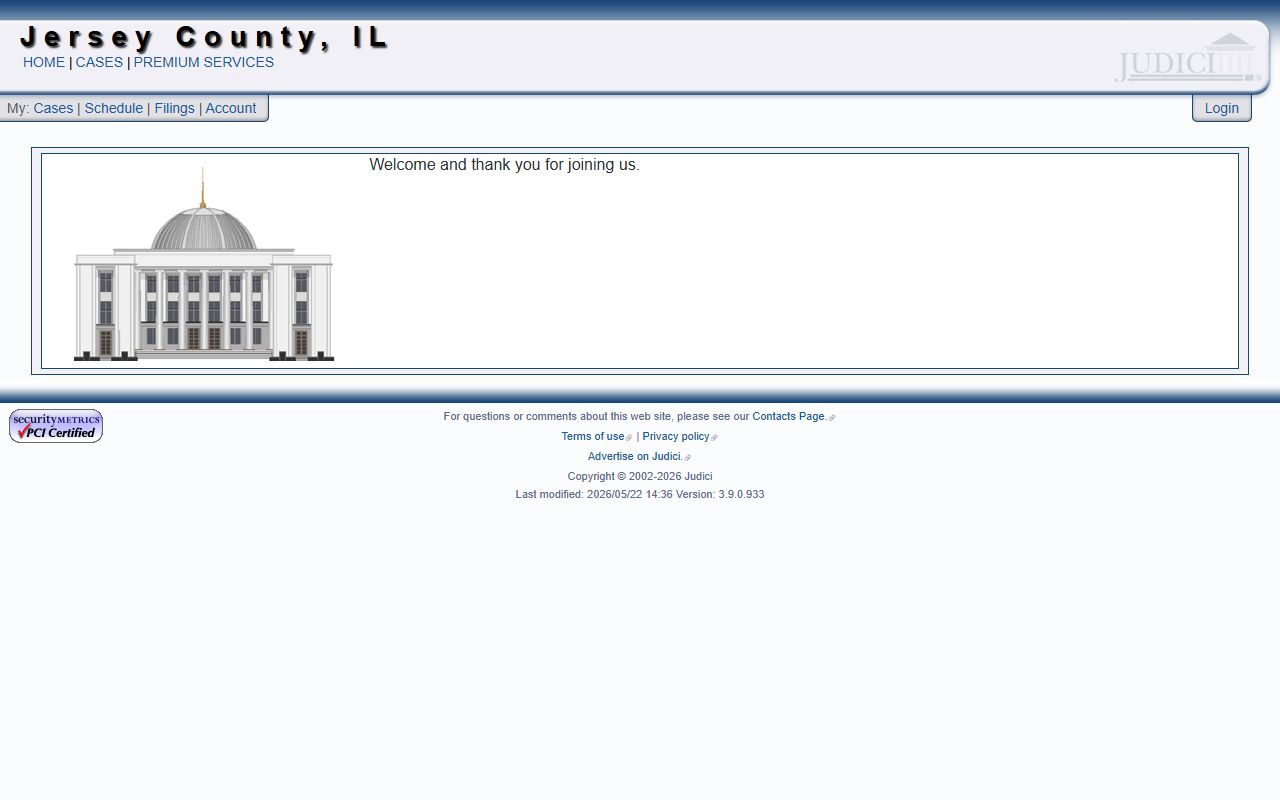
From this page the cases link opens the name search that surfaces charges, hearing dates, and disposition for a Jersey County arrest.
Judici Court Record Search Fields
The Judici search is simple, but the fields matter. The court selection points the search at Jersey County, and the name format is strict. The table lists what the portal accepts and how each part is used.
| Field | Type | Required | Notes |
|---|---|---|---|
| Select Court | Dropdown | Yes | Choose Jersey County, IL from participating courts. |
| Defendant name | Text | Yes for name search | Last name, comma, space, first name. |
| Case number | Text | Optional | Direct lookup if the number is known. |
| Premium services | Login | No | Courtlook and Multicourt need an account; public single-court search does not. |
Judici lists the public data it carries: litigant information, criminal charges, dispositions and sentences, fines and fees, hearing dates, case minutes, and documents. The Judici main page describes the full public-access feature set.
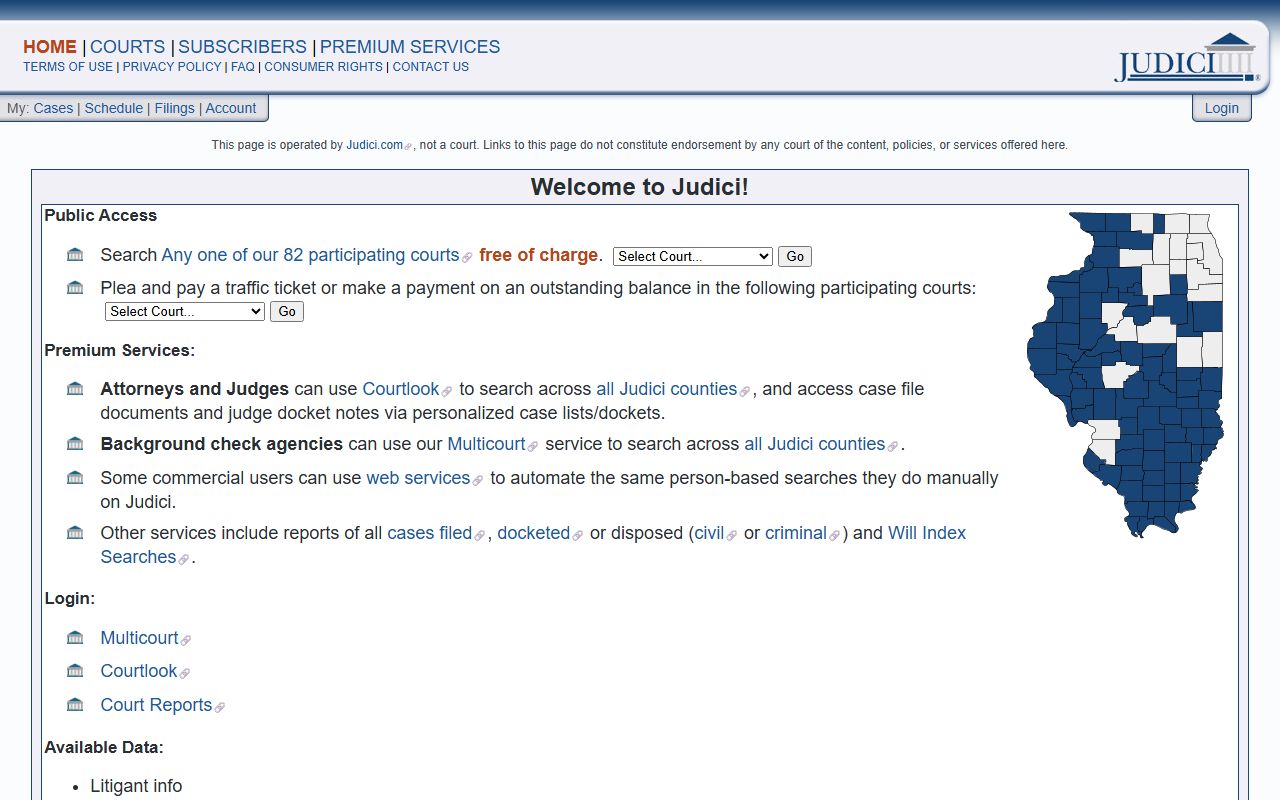
The same page separates the free single-court public search from the paid attorney services, which is useful to know before you click into a premium tool.
How Charges Get Filed After an Arrest: Complaint, Information, and Indictment
The arrest and booking come first, then the charge record begins when the prosecutor files a charging document. Illinois cases can start three ways, and which one is used depends on the seriousness of the offense and the path the case takes. The table sorts the three.
| Complaint | Information | Indictment | |
|---|---|---|---|
| Filed By | Officer or prosecutor | State's Attorney | Grand jury |
| Common For | Misdemeanors, early stage | Many felonies | Serious felonies |
| Starts | The case | The case | The case |
A complaint may be filed soon after arrest and can differ from the final charge. If the State's Attorney proceeds by information or the grand jury returns an indictment, that court filing, not the booking screen, is the authoritative charge.
Charge Status and What It Means
Charges move as a case proceeds. They can be amended, reduced, added, or dropped, and the booking charges on the jail side often differ from what the prosecutor finally files. The terms below appear in Judici case records and tell you where a charge stands.
| Status | What It Means |
|---|---|
| Pending | The charge is filed and active but not yet resolved. |
| Amended / Reduced | The charge was changed, often to a lesser offense. |
| Dismissed | The charge was terminated without a conviction on it. |
| Nolle Prosequi | The prosecutor chose not to proceed on that charge. |
A continued case simply means a hearing moved to a later date. Case minutes in Judici can show that procedural history, including continuances and any warrant entries, where the record is public.
Bond and Release After an Arrest
Illinois changed how release works. For arrests after September 18, 2023, courts no longer use cash bail for new cases. Instead a judge addresses pretrial release, sets conditions, or, in eligible cases, holds a detention hearing where the State's Attorney can ask that the person be held. Older records and legacy web copy may still say "bond," and the sheriff page lists bond as a record item, so treat that word with care and check the current court order.
| Term | How It Works Now |
|---|---|
| Cash bail | No longer the normal system for new Illinois cases; do not assume a payment releases someone. |
| Pretrial release with conditions | The court may release a person on conditions such as reporting or no-contact orders. |
| Detention | The court may order a person held under the pretrial detention framework. |
| Hold or detainer | A warrant or another agency's hold can keep a person in custody even when one case allows release. |
To confirm physical custody, call the jail at 618-498-6881. To confirm the court's release order or the next date, use Judici or contact the Circuit Clerk at 618-498-5571.
Warrants That Lead to an Arrest
An outstanding warrant is a common reason a person ends up booked. No public Jersey County online warrant list was found, so the working channels are the sheriff's phone line for an active local warrant and the court record for a bench warrant tied to a case. A bench warrant is usually issued after a missed court date or a violated order, and it can show as a docket entry in Judici even though there is no separate warrant search.
Do not call 911 to ask about a warrant. Use the sheriff's non-emergency line or the Circuit Clerk, and speak with an attorney before appearing in person, since a warrant carries arrest risk. A warrant from another county or a federal warrant is handled by that jurisdiction, and federal matters in this area run through the U.S. Marshals Service Southern District of Illinois.
Charges vs. Convictions
Being arrested and charged is not the same as being convicted. A charge is an accusation that opens the court record; a conviction is the result after a plea or a verdict. Both are public, but they carry very different weight.
| Charge | Conviction | |
|---|---|---|
| Stage | Accusation | Plea or verdict |
| Burden of Proof | Probable cause | Beyond a reasonable doubt |
| Public Record | Yes | Yes |
A booking photo and an arrest record do not show guilt. The disposition field in the court record is what tells you whether a charge ended in a conviction, a dismissal, or another result.
Sealed vs. Expunged Arrest Records
Illinois lets people clear eligible records after a dismissal or an eligible disposition, through the courts. Sealing and expungement are different remedies, and which one applies depends on the case. The court and the Circuit Clerk handle the process, not a private service.
| Sealed | Expunged | |
|---|---|---|
| Visibility | Hidden from most public view | Destroyed or treated as if it never existed |
| Law Enforcement | Limited access remains | Very limited access |
| Typical Use | Some convictions and dispositions | Arrests without conviction, eligible cases |
If a booking photo is tied to a record that gets sealed or expunged, ask the sheriff and the State's Attorney how that affects any local release of the arrest information.
Background Check Considerations
A casual name search in Judici is not a regulated background check. Formal background checks for hiring, housing, or credit are covered by the Fair Credit Reporting Act and must run through a licensed consumer reporting agency that follows that law. A public court lookup does not meet that standard.
Important: This site is not a consumer reporting agency under the FCRA, and nothing here may be used to decide employment, housing, credit, or insurance.
Court Terms After an Arrest
The court record uses words that have precise meanings, and a few definitions make a Judici case easier to read.
- First appearance
- The first court date after an arrest, where the judge addresses rights, counsel, charges, and release or detention.
- Information
- A charging document filed by the State's Attorney, common for many felonies.
- Disposition
- The outcome of a charge, such as a conviction, a dismissal, or a plea result.
- Bench warrant
- A warrant a judge issues, usually after a missed court date or a violated order.
Restricted Court Records After an Arrest in Jersey County
Not every record is open. Juvenile arrests and juvenile court records are confidential under Illinois law, and the arrest-information statute says it does not override that confidentiality. Sealed and expunged cases drop from public view, dismissed charges may be withheld in part, and details of an active investigation can be held back for safety or law-enforcement reasons. If Judici does not show a case you expect, or returns a humanity check, contact the Circuit Clerk directly at 618-498-5571 to ask about the record.